



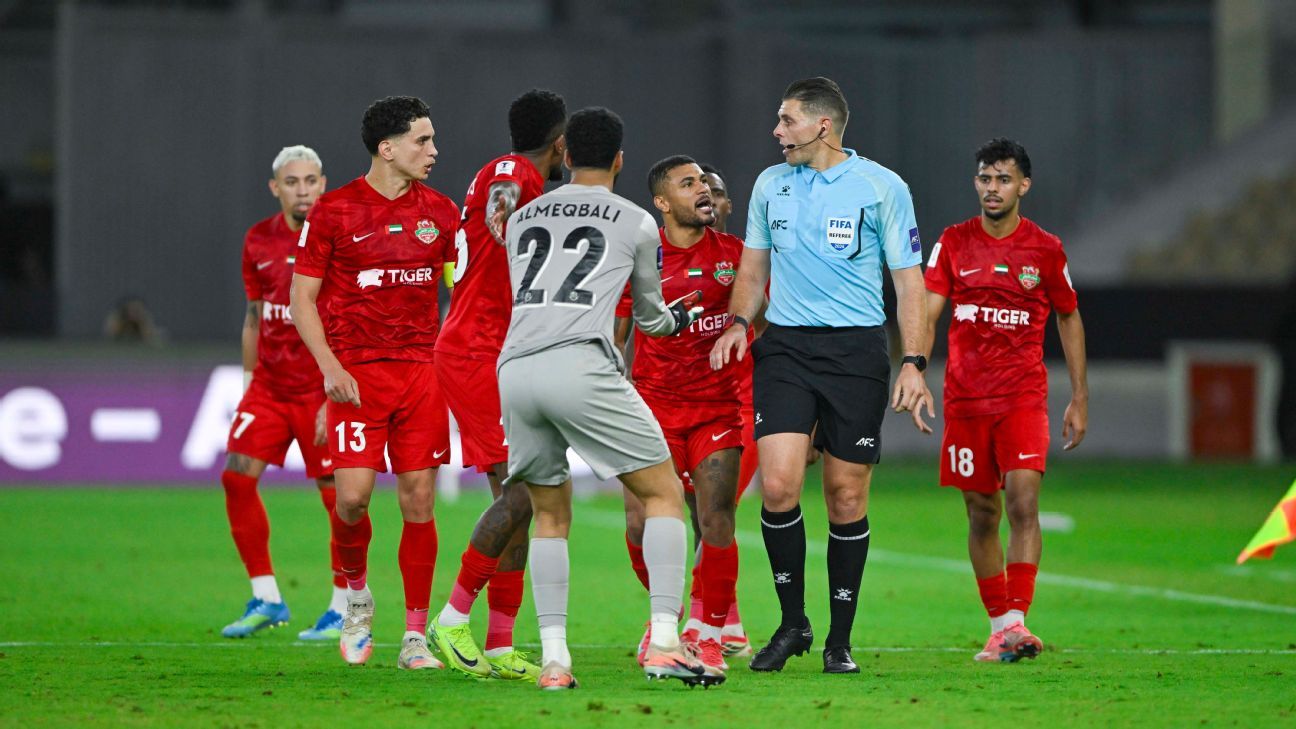

Ugly scenes marred the top of Tuesday’s AFC Champions League Elite semifinal between Machida Zelvia of Japan and United Arab Emirates’ Shabab Al Ahli — and it was maybe comprehensible why the latter had been infuriated by the style wherein they’d simply been eradicated from Asian soccer’s premier membership competitors.
Shabab Al Ahli’s hopes of changing into champions of Asia had simply come to an finish within the penultimate stage of the match with a 1-0 loss, however they had been adamant that tie ought to have been headed for extra-time after their 92nd-minute equaliser was disallowed.
The U.A.E aspect instantly remonstrated with referee Shaun Evans. Then as soon as extra on the ultimate whistle, the place the Australian official ultimately required a police escort off the sphere as he was surrounded by a mob of seething Shabab Al Ahli gamers.
Peculiarly, and maybe for the primary time ever, it was a substitution that led to VAR intervention which prompted Evans to overturn his unique choice of letting Guilherme Bala‘s sensible solo effort stand.
So, what precisely induced the controversy?
After Machida had seemingly made their fifth and ultimate substitution of the tie, they instantly began making appeals to Evans the second Shabab Al Ahli restarted play from a throw-in — though the explanation behind these had been initially unclear.
Shabab Al Ahli labored the best way from one flank to the opposite, the place Bala launched into a blinding 40-yard run and proceeded to skip inside two opponents earlier than unleashing an unstoppable effort within the far nook.
It sparked wild scenes of celebration within the Shabab Al Ahli camp however, nearly instantly, Machida continued their pleas to Evans.
And when VAR — upon conducting its obligatory examine — known as Evans to the pitch-side monitor, issues turned clearer.
As Machida’s Hotaka Nakamura was nonetheless on the sphere of play, briefly exchanging phrases with the person who was about to interchange him in Henry Heroki Mochizuki, Shabab Al Ahli defender Kauan Santos had already thrown the ball again into play.
It then goes right down to the minute particulars. Nakamura was pretty much as good as off the sphere with one foot nearly on the touchline. Barely a second later, Mochizuki was charging onto the pitch.
It initially appeared that Evans had not sensed something was amiss due to such a high-quality margin. And the foundations are the foundations.
Machida will defend the choice by arguing they had been — fairly blatantly — unprepared for the restart, particularly contemplating he was changing Nakamura at right-wingback — down the precise aspect the place Bala produced his second of magic.
Nonetheless, even when it had been a authorized restart, he most likely may not have made it to his designated place contemplating he had the complete width of the sphere to cowl. Certainly, when Bala’s shot hit the again of the online, Mochizuki had solely made it so far as the center of the field — filling within the central function that was vacated by captain Gen Shoji‘s personal masking of the aforementioned void down the best.
Clearly, groups aren’t obliged to attend until their opponents are fully prepared — and of their designated positions — after substitutions. Within the grand scheme of issues, Bala would most likely nonetheless have scored even when Shabab Al Ahli had waited that further second earlier than restarting play. The actual fact of the matter is that they did not.
However this is the place it will get much more intriguing. Evans’ whistle may very well be heard being blown, calling for play to be restarted. Whether or not or not it got here earlier than or after Santos’ throw-in is — once more — so marginal that it’s a troublesome to find out in real-time.
This bit is only conjecture however, on the juncture of the sport when groups are sometimes suspected of bringing on gamers to take time of the clock, and with Machida taking a little bit of time to finish their substitution, he might have — in an try and drive the Japanese group to get on with the sport — known as for Shabab Al Ahli to proceed proceedings.
So, when VAR determined that there was a critical missed incident that warranted an on-field overview, it’s fairly potential that it was one which had truly been instigated by Evans himself. Even then, if he had determined to restart play prematurely as a result of Machida had been losing time, then would not he have been effectively inside his rights to stay by his unique choice?
In any case, there is no such thing as a regulation within the recreation that decrees each groups will need to have 11 gamers on the pitch for the sport to go on. Even discounting the state of affairs of sending-offs, numerical discrepancies are commonplace when gamers require medical remedy off the sphere.
Expectedly, Shabab Al Ahli coach Paulo Sousa — who vacated his dugout for the rest of the competition after the disallowed aim — was indignant after the sport.
“There was a aim that was scored after which it was cancelled — it is a very technical mistake by the referee,” mentioned Sousa. “Sadly, that is what is popping soccer into rubble. It was a giant mistake to decide on this referee for this match.
“What saddens me is the organisation [the Asian Football Confederation] selecting referees who aren’t as much as the standard of this match, these gamers, and the coaches current.”
“We deserved to be within the ultimate and we should play this vital recreation.”
After all, nothing can now change the end result of the competition. It’s Machida who’re transferring on to Saturday’s decider — a narrative in itself contemplating that is their match debut and so they had been nonetheless within the second tier of Japanese soccer as not too long ago as in 2023.
Nonetheless, Shabab Al Ahli are effectively inside their rights to be aggrieved that they didn’t at the least have extra-time, and even penalties, to drag off a victory of their very own.
Not for the primary time, VAR has courted controversy. However maybe for the primary time, over a substitution.
