




Historical past was rewritten Tuesday night time as Senegal have been stripped of the Africa Cup of Nations that they — and many of the world — thought they’d gained in January. Fifty-eight days later, the title of African champion goes to Morocco, due to a ruling by the enchantment physique of the Confederation of African Soccer (CAF).
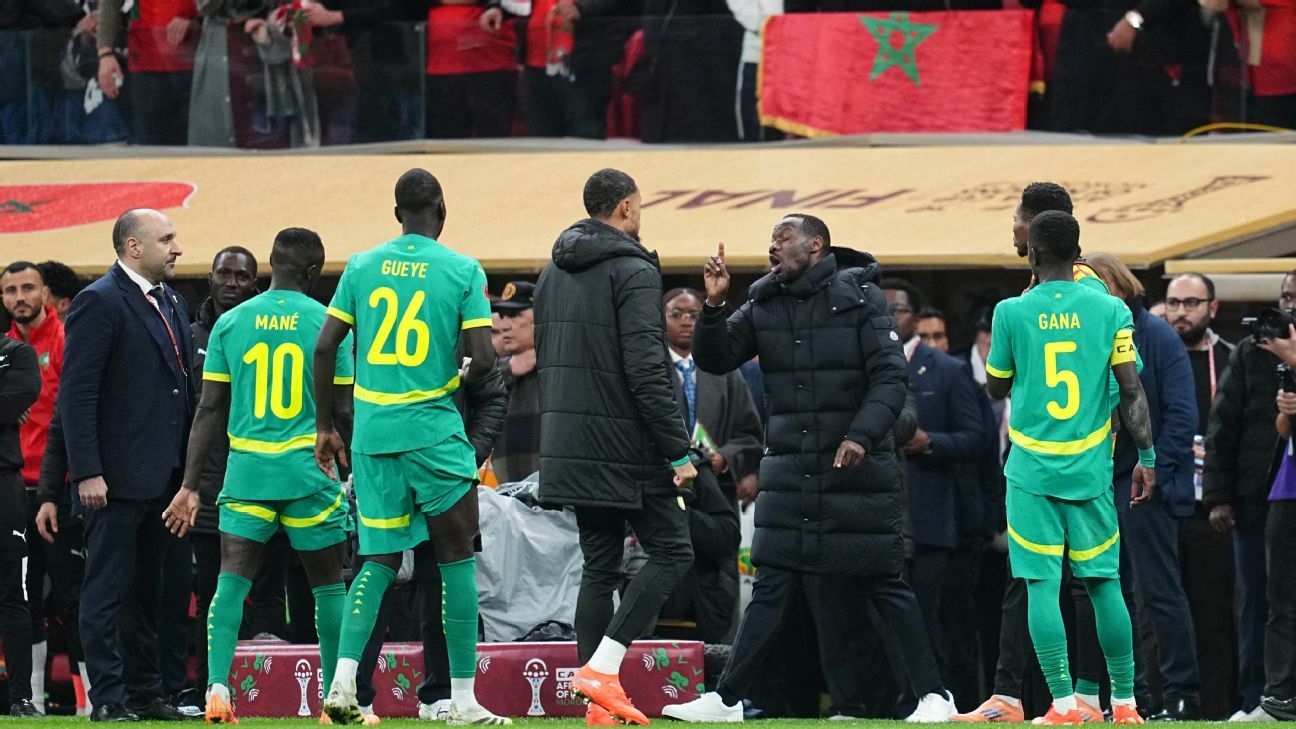
You may keep in mind the drama of that last. Just a few huge calls, together with a disallowed purpose, went in opposition to Senegal. Then the event hosts Morocco have been awarded a extremely contentious penalty, through the Video Assistant Referee (VAR), deep in damage time. The Senegal gamers protested and, nearly to a person, walked off the pitch and down the tunnel, led by their coach, Pape Thiaw. Those self same gamers returned some 10 minutes later, grudgingly reentering the pitch.
Play resumed a full 17 minutes after it was halted, with Morocco’s Brahim Díaz taking an ill-advised “Panenka-style” penalty kick that was simply saved by Senegal keeper Édouard Mendy, forcing the sport into further time. And within the first extra time interval, Pape Gueye scored the purpose that gave Senegal a 1-0 win amid a backdrop of fan unrest, chaos, gamers squabbling with ball boys, and unhealthy blood throughout.
All that’s gone now and, from a strict studying of each the event rules and the Legal guidelines of the Recreation, it is the proper choice. Justice was executed. Justice delayed, thoughts you, as a result of it by no means ought to have taken this lengthy, however justice nonetheless.
Article 82 of the CAF rules is crystal clear: “If, for any purpose in anyway, a crew … depart the bottom earlier than the common finish of the match with out the authorisation of the referee, it shall be thought of looser [sic] and shall be eradicated for good from the present competitors.” Article 84 goes on to state that in case you contravene Article 82 you “will lose [the] match by three-nil.”
That is it. That is all you actually need to know. You may’t abandon the sector of play with out permission throughout a recreation and, in case you do, you forfeit. It is fairly fundamental, common and customary sense: You refuse to play, you lose. Refereeing misdeeds, hostile crowds, frustration, no matter … none of those justify strolling off.
The query to ask is not whether or not CAF’s appeals physique bought it proper. It did; the rules actually depart no room for argument. Fairly, it is how issues bought this far and took this lengthy.
The referee himself, Jean-Jacques Ndala Ngambo, may have dominated the sport a forfeit on the night time. If gamers depart the sector of play with out his permission, he’s imagined to subject yellow playing cards, and if they do not return inside a “cheap period of time,” he has the facility to desert the match and name it for the opposite crew. What’s a “cheap period of time”? It is not specified; nevertheless, frequent sense would counsel {that a} “cheap period of time” is significantly lower than what we noticed on that night time.
Why did not the referee do that? We do not know. He had made some unhealthy calls earlier within the recreation, and perhaps he felt he had some discretion to not finish the showcase occasion of African soccer on this manner. In that sense, in these moments, he appeared just like the loneliest man on Earth.
What ought to have occurred (and apparently didn’t, although we could by no means know) is somebody — CAF’s head of referees, a CAF official, somebody — getting in his ear and reminding him that this was his name to make and empowering him to easily apply the foundations. If that did not occur, I certain as heck am not going guilty him for doing the whole lot in his energy to complete the sport.
However that does not exonerate CAF for what occurred subsequent.
The next day, Jan. 19, Morocco filed their enchantment with the CAF disciplinary board, asking for a Senegal forfeit. 9 days later, they got here out with their choice, suspending a bunch of gamers and officers, issuing heavy fines to each groups and gamers (together with a five-match ban for Senegal boss Thiaw) however, crucially, rejecting the Moroccan enchantment for a forfeit.
Why? We could by no means know, however the impression is that with a lot chaos surrounding the match and with allegations of favoritism towards the host nation, Morocco, together with unhealthy publicity worldwide, they — a bit just like the referee on the night time — did not really feel empowered to easily apply their very own guidelines.
Per week later, on Feb. 3, Morocco formally filed their paperwork with the CAF appeals board. It took it six weeks to succeed in a choice: Senegal forfeit the sport, Morocco are champions, although they might need to maintain off on the celebrations.
Senegal have already exercised their proper to enchantment the choice to the Court docket of Arbitration for Sport (CAS). You’d anticipate them to just do that, maybe arguing that for the reason that referee selected to not abandon the match after the walk-off and the gamers finally returned, Article 82 doesn’t apply and that, finally, a 17-minute delay of recreation — from the second the penalty was awarded to when it was truly taken — does not warrant the stripping of a title. And that may possible kick the can down the highway one other two to a few months.
Regardless of the final result, it is going to be binary. There is no such thing as a potential CAS verdict that may fulfill each side or that will likely be seen as “simply” by all. (Within the eyes of 1 CAS arbitrator, Raymond Hack, this enchantment will finish in Senegal’s favor.)
So, for now, the primary takeaways for CAF.
The primary is that disciplinary processes shouldn’t take this lengthy. This actually is not that sophisticated — there aren’t reams proof to sift by means of. You both really feel that Senegal’s walk-off warranted a forfeit (like me) or you do not, as a result of they finally returned and the referee did not abandon the sport.
The opposite is that refereeing in these circumstances is tough and, above all, lonely. Leaving the match official on his personal to take a choice like that is one thing that ought by no means to occur once more.
