




Video Assistant Referee causes controversy each week within the Premier League, however how are choices made, and are they right?
After every weekend, we check out the main incidents, to look at and clarify the method when it comes to VAR protocol and the Legal guidelines of the Sport.
On this week’s VAR Evaluate: Ought to Brentford‘s stoppage-time equaliser towards Chelsea have been disallowed? Why was a Tottenham Hotspur objective at West Ham United dominated out? And may Wolverhampton Wanderers have been decreased to 10 males at Newcastle United?
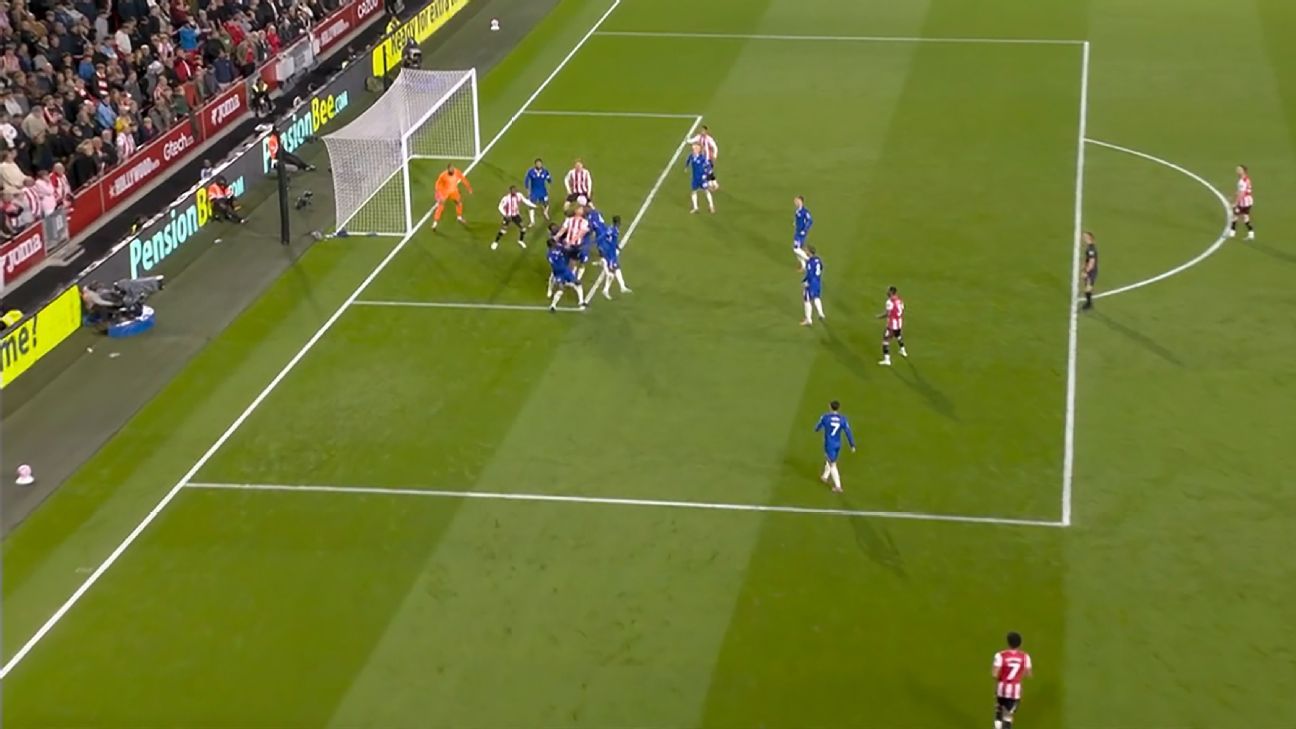
Attainable offside: Ouattara on Carvalho objective
What occurred: Brentford scored an equaliser three minutes into stoppage time when Fábio Carvalho guided the ball house after Kristoffer Ajer had flicked on Michael Kayode‘s lengthy throw. Because the gamers celebrated, the VAR, James Bell, checked for a attainable offside offence inside the transfer by Dango Ouattara.
VAR choice: Objective stands.
VAR overview: This went underneath the radar amid the drama of Brentford’s late objective, and plenty of are most likely unaware there was an offside test towards Ouattara.
You’ll be able to’t be offside from a throw-in, however when Ajer touches the ball, that creates a section and Ouattara was simply forward of Chelsea defender Reece James. Ouattara did not contact the ball, so it was a subjective judgement for the VAR to find out affect.
Ouattara cannot commit an offence by his place alone. He is not blocking the imaginative and prescient of James, and would not run throughout the road of the ball. However the legislation does say {that a} participant can’t be “clearly making an attempt to play a ball which is shut when this motion impacts on an opponent.”
Ouattara caught out a leg because the ball went by means of to Carvalho, so one a part of the clause is glad. However did that affect James?
The on-field crew advised the VAR that they knew Ouattara was offside however that they did not really feel he did something to set off an offence so the objective was given.
Verdict: It is going to cut up opinion, and it relies upon the way you weigh up one essential facet; the ball was previous Ouattara and in entrance of James when the Brentford participant made an try to the touch the ball, does that create sufficient of an affect on the defender for VAR to intervene?
Had Ouattara tried to play the ball instantly because it went previous him, thus influencing James’ calculation of the flight of the ball, it is a a lot clearer offside offence.
As Ouattara made a late motion, it created doubt over the extent of affect with James totally targeted on the ball and failing to make contact.
Whereas it may need appeared like a fast test, it did take 1 minute 28 seconds — slightly longer than the jubilant objective celebration. When the tv protection switched to the VAR output, you could possibly see that Bell was weighing up the timing of Ouattara’s motion.
Relying on who was on VAR obligation you could possibly get a special final result. It is one of many over-riding points with VAR, as a result of it is simply one other layer of subjective interpretation and referees will not all the time agree. Likewise, followers can argue about this interpretation — and neither facet could be incorrect of their view.
VAR interventions to rule out targets when the attacker is not involved with a defender are uncommon. Final season, it occurred solely as soon as, in Nottingham Forest vs. Southampton, and that was logged as an error by the Premier League’s Key Match Incidents (KMI) Panel. An offside Chris Wooden tried to go the ball and the VAR, Graham Scott, incorrectly suggested that he had impacted the defenders.
We even have proof of the VAR leaving such a scenario alone. In January 2022, an offside Roberto Firmino, who was being marked by Tyrick Mitchell, jumped to go a cross, missed it and the ball went to Alex Oxlade-Chamberlain, who scored. The VAR decided that the Liverpool ahead did not affect upon Mitchell, because the Crystal Palace defender had no probability of taking part in the ball. It was a barely totally different scenario, but it surely exhibits how an offside participant “clearly making an attempt to play a ball” will be deemed to haven’t any affect. (watch right here)
That is way more prone to be given on the sector and upheld, even when that appears harsh — Southampton’s disallowed objective vs. Brighton final season being an ideal instance.
PGMO will likely be content material that the objective has been allowed to face. In spite of everything, it is triggered little or no controversy — and which will have been very totally different had the objective been chalked off.
Each outcomes are justifiable, so leaving this with the on-field name is ok.
Attainable objective: Foul problem by Van de Ven on Walker-Peters
What occurred: Tottenham Hotspur received a nook within the nineteenth minute. It was delivered into the realm by Mohammed Kudus, with Cristian Romero rising unmarked to go into the online on the close to put up. Nevertheless, referee Jarred Gillett instantly blew for a foul, ruling that Kyle Walker-Peters had been pushed by Micky van de Ven. It was appeared on the VAR, John Brooks.
VAR choice: No objective.
VAR overview: This was an exceptionally comfortable free kick given by the on-field referee, and upheld by the VAR as a result of Van de Ven had two palms on Walker-Peters.
Van de Ven did transfer into Walker-Peters and positioned his palms on him, inflicting the West Ham United participant to stumble over Romero, but it surely wasn’t fairly so easy.
The chain response was attributable to Hammers midfielder Mateus Fernandes, who was angered by an preliminary tussle with Van de Ven and barged into the again of the Spurs participant. This knocked Van de Ven into Walker-Peters, and triggered Walker-Peters to go down.
So you may argue this was attributable to Fernandes, and Van de Ven was an harmless bystander.
Verdict: “Actually the referees & VAR have had an absolute shocker of a begin to the season,” Spurs midfielder James Maddison wrote on X on Saturday night. “If that objective is disallowed for a foul you’ll by no means ever see a nook be taken with out referee blowing for one thing ever once more.”
It was traditional footballers’ hyperbole from Maddison, as a result of comfortable free kicks are given on set items on a regular basis — it is simply that they’re often referred to as with out the ball ending up at the back of the online.
And if we take a look at the proof, VARs ignoring these choices within the Premier League is nothing new. We’re into the sixth season of VAR, and in that point only one objective has been awarded after an incorrect foul on the pitch — when Newcastle United’s Bruno Guimarães was initially penalised for a foul on Leicester Metropolis goalkeeper Kasper Schmeichel in April 2022.
Over the identical interval, the VAR has suggested that 40 targets must be disallowed on overview for a foul. It is close to inconceivable to get a objective awarded, however VARs will step in to offer a foul a number of instances a season.
Supporters get irritated as a result of among the many 40 they see minimal infringements (see Josh King‘s objective for Fulham at Chelsea earlier than the worldwide break), but it surely by no means falls the opposite means with referees just about all the time supported once they disallow a objective. The excessive threshold sees completely good targets that keep dominated out, as a result of a lot weight is placed on the on-field choice.
Final month, Brentford had a objective dominated out by the referee towards Aston Villa when Nathan Collins was judged to have fouled goalkeeper Emiliano Martínez. It was extremely comfortable, with the KMI Panel voting 5-0 that it must be a objective on the sector, however 4-1 that it did not attain the edge for an intervention.
There’s one other apparent comparability to Manchester United‘s Leny Yoro getting away with placing two palms at the back of Fulham’s Calvin Bassey — with the on-field choice of objective being upheld. This time the KMI Panel voted 3-2 that it was a foul, however 4-1 that it should not be modified on overview.
The objective actually must be given by means of VAR, however there must be no expectation it is going to be within the Premier League.
Attainable penalty: Problem by Fernandes on Van de Ven
What occurred: Tottenham received eight corners within the first half, and every noticed a good quantity of pushing and shoving. On this set piece, Fernandes and Van de Ven each went to floor on the again put up however referee Gillett allowed play to proceed.
VAR choice: No penalty.
VAR overview: Premier League referees and VARs have been advised to clamp down on clear examples of holding this season, but it surely’s nonetheless an interpretation of a number of components.
The referee has determined that the 2 gamers had been concerned in mutual holding, and it was ultimately Van de Ven that pulled down the West Ham participant — but it surely’s not troublesome to come back to a special conclusion.
Fernandes has his again to the play and no real interest in taking part in the ball, and that is an indicator of a non-football motion which ought to lead to a penalty.
Verdict: If there’s mutual holding, it will all the time carry weight with the VAR however Fernandes was very lucky and it was most likely just under the edge for an intervention.
For supporters, although, it is going to appear unusual {that a} nothing foul to disallow a objective is upheld, however this type of holding offence is not penalised.
Earlier than the worldwide break, Brentford needed a penalty for a foul by Sunderland‘s Reinildo Mandava on Nathan Collins, however the VAR did not step in. The KMI Panel voted 5-0 that this was an on-field penalty, but it surely was cut up 3-2 towards a VAR overview — this example most likely falls into that very same class.
Attainable red-card overturn: Foul by Soucek on Palhinha
What occurred: João Palhinha was caught by a excessive problem from Tomás Soucek within the 54th minute, with referee Gillett instantly producing the crimson card. It was checked by the VAR. (watch right here)
VAR choice: Crimson card stands.
VAR overview: A really clear crimson card for the West Ham midfielder. He went into the problem with a raised foot, with studs main and a straight leg which made contact on Palhinha’s shin — ripping his sock.
A straight leg is seen as extra harmful as there isn’t a give within the problem, which means the entire drive of the contact is felt by the opponent. With a bent leg, this may be judged as much less impactful because the drive is retracted.
Verdict: After a season when Premier League referees got here in for lots of criticism for poor identification of great foul play offences, main to a few missed VAR interventions for crimson playing cards, two extra which ought to have been given on-field (however to not the VAR threshold) and a report quantity (4) of dismissals overturned on enchantment, it is solely truthful to determine good choice making.
Likewise, you may level to the VAR intervention to point out a crimson card to Newcastle’s Anthony Gordon vs. Liverpool, with Brooks on VAR for that match, too.
Attainable DOGSO: Mosquera problem on Barnes
What occurred: Harvey Barnes ran onto a ball excessive within the twentieth minute, however went to floor underneath strain from Yerson Mosquera. Referee Chris Kavanagh wasn’t enthusiastic about a foul, and allowed performed to proceed. The VAR, Tim Wooden, thought-about a attainable case of denying an apparent goal-scoring alternative (DOGSO). (watch right here)
VAR choice: No crimson card.
VAR overview: The potential foul occurred simply outdoors the penalty space, so the VAR can solely think about a crimson card for DOGSO.
Had Kavanagh given the free kick towards Mosquera, the VAR would solely be deciding upon the standard of the goal-scoring alternative. However Wooden is left with two subjective calculations — each the foul and DOGSO.
Verdict: Wooden has determined this was simply two gamers jostling for possession and that Barnes was not in charge of the ball, however Mosquera appeared to steer together with his arm into the top of Barnes — and that is greater than only a regular battle for the ball.
It could seem that the ball ran to goalkeeper Sam Johnstone, and away from Barnes, however that solely occurred as a result of it got here off the chest of Mosquera as he fell to the bottom. That needs to be faraway from the consideration, so we’ve got the ball dropping into the trail of Barnes.
Barnes might not have management of the ball in the intervening time of the problem, however the DOGSO legislation additionally considers the chance of him doing so — and it was straight in entrance of him with the fast probability of a contact and a shot.
Should you suppose this was foul, and it was, then the bins are ticked for a crimson card. By making the problem on Barnes with a excessive arm, it ought to have been a foul and a VAR intervention.
Attainable crimson card: Foul by Ugochukwu on Mac Allister
What occurred: Lesley Ugochukwu was proven a yellow card by referee Michael Oliver for a late problem on Alexis Mac Allister within the sixteenth minute. It was checked by the VAR, Paul Tierney, for a attainable crimson card for critical foul play. (watch right here)
VAR choice: No crimson card.
VAR overview: There is a set of issues, influenced by one another, {that a} VAR makes use of to find out critical foul play. This choice is an efficient instance of how these components must be weighed up collectively.
Excessive up on the record is the buckle of the ankle, as that signifies the next stage of drive. That is current right here, so why wasn’t the referee despatched to the monitor?
Because the contact by Ugochukwu was low and simply above the boot, there is a better chance that the problem may trigger the buckle. Contact on the shin with a buckle is a extra dependable indicator of drive. So, different components are equally as necessary.
Ugochukwu is available in from a really quick distance, suggesting decrease drive, and it is reckless reasonably than endangering the protection of an opponent.
Verdict: Tierney has had points with figuring out critical foul play in current seasons however this may be thought-about an “orange” card, someplace between a yellow and a crimson, and we should not count on it to be upgraded on overview.
Attainable penalty overturn: Handball by Hannibal
What occurred: Liverpool had been awarded a penalty within the third minute of stoppage time when the cross from Jeremie Frimpong was blocked by the arm of Hannibal Mejbri. Referee Oliver pointed to the spot, and it was checked by the VAR.
VAR choice: Penalty stands, scored by Mohammed Salah.
VAR overview: Hannibal turned and raised his arm into the trail of the ball, creating a really clear barrier. It is an apparent penalty, and the Burnley participant knew it.
Verdict: Final season, solely two handball penalties had been awarded with out VAR intervention. This season, there’s already been 5 and we’re solely 40 video games in.
Attainable disallowed penalty: Encroaching by Frimpong
What occurred: Salah scored Liverpool’s successful objective from the penalty spot within the ninety fifth minute, however Frimpong was already inside the realm when the kick was taken. Ought to there have been a retake?
VAR choice: Objective stands.
VAR overview: VAR has all the time been about judging affect to trigger an intervention. When the protocol round penalties and encroaching was drawn up, it was determined that the VAR should not intervene in if a participant had simply stepped into the realm too early — they should have a cloth impact on the end result by, as an example, scoring or clearing a rebound.
But it was successfully a two-tier legislation, as encroachment nonetheless remained an absolute offence (although hardly ever enforced) for the on-field crew in any respect ranges of the sport. So on that foundation, the actions of Frimpong could possibly be penalised.
However the legislation was modified in the summertime to carry all the pieces according to VAR protocol — Frimpong being inside the realm is now not a retake offence for the referee and his assistants both.
Frimpong may nonetheless commit an offence by coming into the realm too early, however it could should be very apparent and delay the goalkeeper — and that is not possible to occur.
Attainable penalty overturn: foul by Van Hecke on Evanilson
What occurred: Evanilson moved into the realm within the 59th minute, and as he appeared to chop again inside he went down underneath a problem from Jan Paul van Hecke. Referee Peter Bankes pointed to the spot, and it was checked by the VAR, Paul Howard.
VAR choice: Penalty stands, scored by Antoine Semenyo.
VAR overview: Van Hecke dangled a leg out in entrance of Evanilson, and the AFC Bournemouth striker used the small quantity of contact and goes to floor.
Verdict: There was solely a small quantity of contact, however as soon as it has been given there isn’t any prospect of a VAR overturn.
Earlier than the worldwide break, we noticed a attainable penalty scenario which the KMI Panel logged as an error, one in every of three up to now this season. Wolves needed a spot kick for Hugo Bueno, who had stepped inside and went down after being caught by Everton‘s Iliman Ndiaye. It was a 3-2 vote that the VAR ought to have stepped in to advise a penalty.
Van Hecke is not fairly the identical, but it surely exhibits some similarities with how the Brighton participant was caught out by the motion of an opponent.
